






























How To Implement AI Voice Ordering For Restaurants: Benefits and Use Cases

 Share -



- 01How Does Voice Ordering Work?
- 02Advantages of AI Voice Ordering in Restaurants
- 03Essential Voice AI Capabilities for Multi-Location Restaurant and Hotel Chains
- 0410 Use Cases and Real World Examples of AI Voice Ordering in Restaurants
- 05How to Implement Voice AI in Your Restaurant
- 06Voice Ordering System Challenges and How to Solve Them
- 07How Appinventiv Can Implement an AI Voice Ordering System?
- 08FAQs

Key takeaways:
- The use of AI voice ordering simplifies restaurant tasks, reduces the number of erroneous orders, accelerates the order-taking process, and allows employees to focus on serving customers.
- Individual recommendations and the ease of use of the loyalty program keep customers satisfied and increase their likelihood of return.
- Voice ordering solutions support different languages and accents, which simplifies the ordering process of order and makes it more friendly to various types of customers.
- The implementation of AI voice ordering is associated with evident ROI in the areas of improved order accuracy, increased average ticket amounts due to upselling, and reduced labor expenses.
A customer calls a restaurant during the dinner rush. The phone keeps ringing because the staff is busy serving guests and preparing orders. After waiting briefly, the customer hangs up and orders elsewhere. For one restaurant, that is a missed order. Across hundreds of locations, it becomes a sizable revenue gap.
This matters even more as the restaurant industry grows. The U.S. restaurant and foodservice market is expected to generate $1.55 trillion in sales by the end of 2026. Yet growth alone does not guarantee that every restaurant will capture its share. Customers still expect quick responses, accurate orders, simple payments, and consistent service across every channel.
Voice AI helps restaurants meet these expectations without placing more pressure on store teams. It can answer calls, take drive-thru orders, understand menu changes, suggest relevant add-ons, process payments, and send confirmed orders directly to the POS. The customer gets served, while employees stay focused on food and in-person guests.
Major restaurant brands are already testing this opportunity at scale:
- SoundHound’s phone-ordering technology has handled more than 100 million restaurant interactions.
- Casey’s expanded Voice AI across more than 2,600 stores after processing over 21 million customer conversations.
- Donatos achieved 99.9% order accuracy after introducing Revmo across 174 locations.
- Yum! Brands also deployed an NVIDIA-powered voice agent within three months back in 2025, with plans to extend the technology across 500 restaurants.
These are no longer small experiments. They show how Voice AI is becoming a serious ordering channel for restaurant and hospitality groups. The real opportunity lies in connecting it with menus, POS platforms, loyalty programs, payments, inventory, reservations, and location-level reporting.
For restaurant chains, the value of restaurant voice AI extends beyond answering customer calls. A well-integrated restaurant AI agent can recognize intent, check item availability, suggest relevant additions, process payments, and send accurate orders to the appropriate location. This makes voice AI for restaurants an operational channel rather than a standalone customer service tool.
This blog looks at how Voice AI ordering works, the use cases worth considering, and the returns restaurants can measure. It also covers implementation steps, multi-location rollout, and the challenges operators should solve before taking the system live.
Let us help you integrate voice AI ordering, keeping customers satisfied and revenue steady

How Does Voice Ordering Work?
Voice ordering for restaurants begins when the system captures a customer’s request through a phone line, drive-thru intercom, mobile application, or smart device. AI voice agents for restaurants then convert speech into structured order data, apply menu rules, confirm modifications, and transfer the final request to the POS and kitchen.
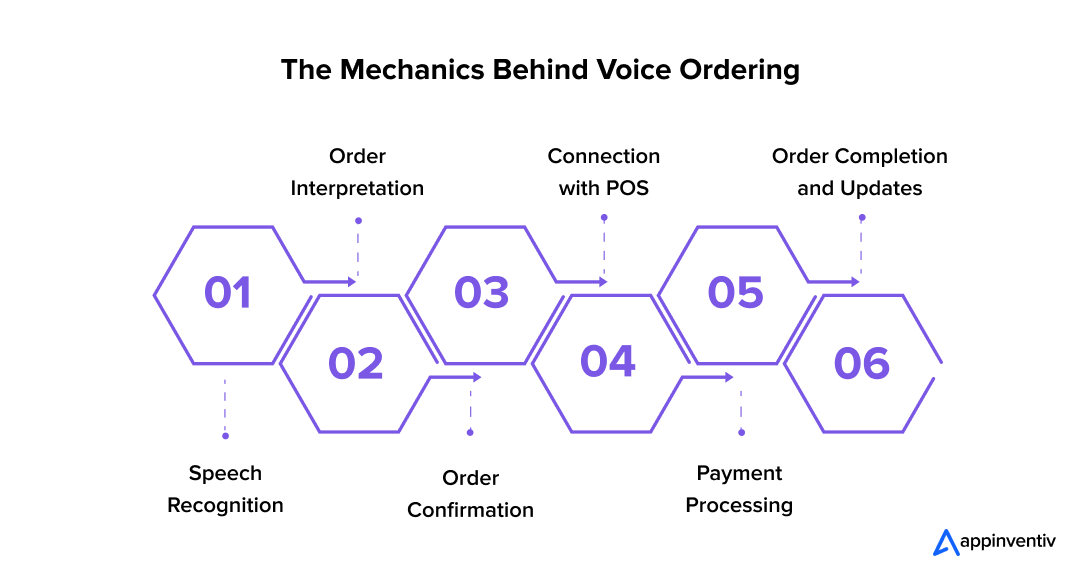
- Speech Recognition: The system picks up spoken words using drive-thru voice AI or app microphones and turns them into text with natural language processing.
- Order Interpretation: AI analyzes the request, matches it to menu items, applies any necessary changes, and verifies availability using food ordering automation tools.
- Order Confirmation: The system reads back or shows the understood order for customer approval, lowering the chance of mistakes before sending it through.
- Connection with POS: Once approved, the order is processed directly into the point of sale system, supporting larger restaurant digital transformation efforts by streamlining operations.
- Payment Processing: Customers can complete transactions using saved cards, loyalty rewards, or mobile wallets, assisted by a voice assistant for restaurants that ensures the process remains secure and contactless.
- Order Completion and Updates: The AI tracks preparation and delivery status, giving real-time updates that keep customers informed and satisfied.
To better understand how the voice ordering system works for both customers and restaurants, let’s check out a comparison table below:
| How Voice Ordering Works | |
|---|---|
| For Restaurants | For Customers |
| Sign up with a voice ordering provider. | Access via phone, app, drive-thru, Alexa, Google Home, or website. |
| Menu is mapped with items, modifications, and upsell options. | System prompts for order and offers suggestions. |
| Past orders and machine learning refine recommendations. | Order is confirmed and payment processed (card on file optional). |
| Orders flow to POS and kitchen display system. | Order sent directly to POS and kitchen for prep. |
| Kitchen prepares for pickup or delivery. | Customer receives order through pickup, delivery, or drive-thru. |
A connected AI restaurant ordering system keeps the conversation, menu, payment, loyalty, and kitchen workflows synchronized. Unlike basic call automation, a restaurant AI voice agent can manage order modifications, unavailable items, upselling prompts, and location-specific pricing without requiring an employee to re-enter the information.
This vertical flow illustrates how voice ordering is not only able to simplify the work of the restaurant business and automate menu navigation, order routing, and payment processing, but also provides the customer with a better experience; faster service delivery, personalized recommendations, and various convenient ordering options.
A direct interface between AI-driven systems and the POS and kitchen processes can help restaurants achieve higher accuracy, less waiting time, and consistency between drive-thru and app orders and delivery orders.
Appinventiv’s Insights
Voice ordering delivers the best results when restaurants begin with straightforward menu options and allow the technology to understand what customers want over time. When you connect AI ordering systems with your existing loyalty programs and inventory tracking right from the beginning, each customer interaction becomes valuable data that improves how smoothly everything runs, reduces mistakes, and keeps customers satisfied.
Advantages of AI Voice Ordering in Restaurants
AI voice ordering is changing how restaurants work with their customers and run their daily operations. The business value of AI voice for restaurants comes from its ability to handle repetitive conversations without compromising speed or consistency. Whether customers call a restaurant or order at a drive-thru, the system can follow the same menu, confirmation, and service rules during every interaction. Here are some of the benefits of implementing AI voice ordering system in restaurants:
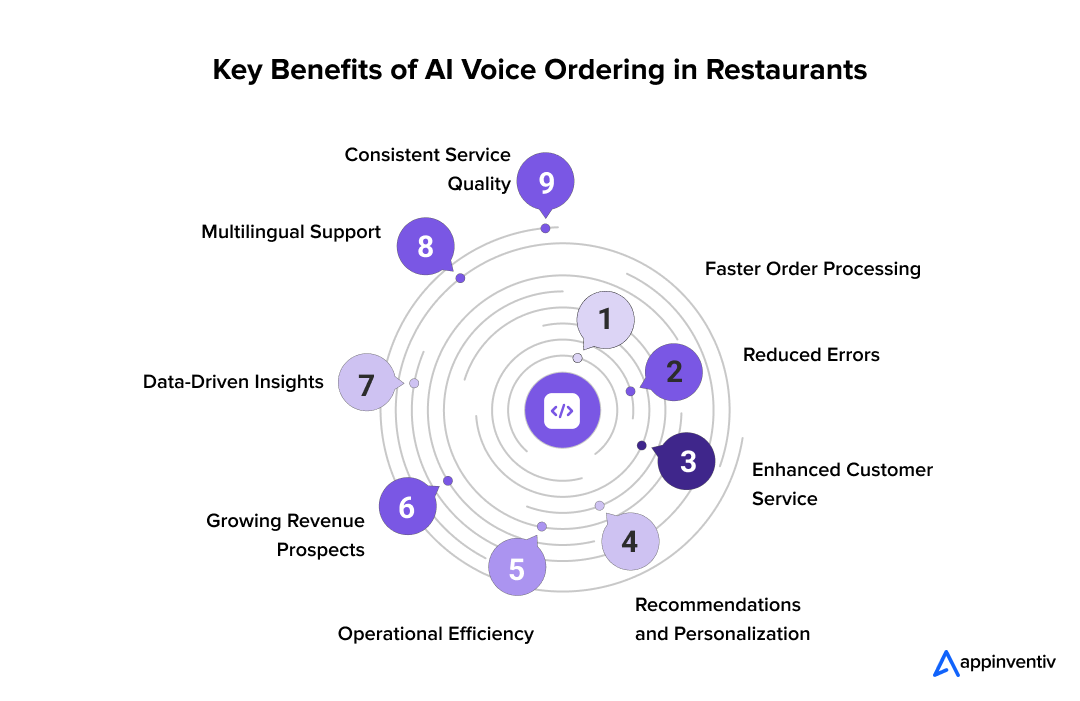
Faster Order Processing
The voice recognition artificial intelligence enables customers to instantly make an order by speaking to the machine, which reduces waiting time. Orders are placed directly in the kitchen and do not need to be manually entered or relayed.
This fast rate increases the amount of table turnover on busy days, decreases the waiting line, and allows the staff to spend more attention on food service and preparation What comes out is a more efficient, smooth working that is beneficial both to the customers and the restaurant teams.
Reduced Errors
Order-taking, traditionally, may be subject to error, through hearing an order wrong, or by typing it into a manual incorrectly. AI voice ordering records all the instructions with accuracy, precision, and consistency.
Through error reduction, restaurants are able to reduce food wastage, eliminate complaints by customers, and ensure reliability in the services provided. This precision increases the total customer confidence towards the brand as well.
Enhanced Customer Service
The voice ordering is a convenient, hands-free feature that allows the customer to communicate with restaurants. It enables the clients to make their orders without waiting in a queue or repeating themselves.
AI offers a seamless customer experience that is contemporary and intuitive, thereby enhancing satisfaction and driving repeat visits. The process should be quick and user-friendly, because the chances of a customer revisiting it again are higher.
Recommendations and Personalization
Artificial intelligence could be used to audit past purchases and tastes of customers to give them personalized recommendations. It can suggest successful dishes, upsell, or new products that match personal preferences.
AI voice ordering systems are personalized, allowing diners to discover what they may like on the menu and encouraging them to return for repeat business. Customers become appreciated and identified, which enhances loyalty.
Operational Efficiency
The combination of AI voice systems, POS ,and inventory systems enables restaurants to streamline workflow and staffing. The technology is capable of prioritizing the orders, predicting the peak demand, and reducing kitchen bottlenecks.
The managers will gain a better understanding of operational trends, enabling them to make smarter decisions and coordinate more effectively between the front-of-house team and the back-of-house team. Efficiency realizations lead to cost minimization and enhanced service reliability.
Voice AI solutions for restaurant operations can also distribute incoming orders according to kitchen capacity, outlet availability, operating hours, and fulfilment type. This coordination helps restaurant groups manage peak demand without overloading employees or sending orders to the wrong location.
Growing Revenue Prospects
Voice ordering AI can be used to increase upselling and cross-selling, either by proposing additional purchases or deals throughout the ordering phase. This will make customers make additional purchases without the feeling of being pressured.
Restaurants can subtly alter the ordering behavior to boost average order value, total revenue, and enhance the customer experience.
Data-Driven Insights
Every voice interaction generates valuable data on customer preferences, peak ordering times, and popular menu items. This information can be used by the restaurant to refine the menus, to ensure better staffing, and to make strategic business decisions. When combined with advanced restaurant analytics, this data becomes a powerful tool for protecting profit margins during periods of economic uncertainty and inflation.
Trends or gaps in service are also detected with the help of analytics to provide the management with the insights they need to remain competitive and responsive to customer needs.
Multilingual Support
The AI voice systems can identify various languages and accents; therefore, restaurants can serve a wide range of customers. This is possible to eliminate communication barriers and make all customers feel welcome and understood.
It broadens the services of the restaurant, brings in more visitors, and increases the general satisfaction of the non-native speakers.
This capability is particularly important when voice ordering for restaurants is introduced across locations serving customers with different accents and language preferences. The system must understand local menu terminology while maintaining the same confirmation and accuracy standards across the brand.
Consistent Service Quality
Voice ordering is automated, this means that there is uniformity of service, independent of the staff experience or workload. All orders are collected with equal precision and efficiency, upholding brand standards.
This consistency instills customer confidence and minimizes variability due to human mistakes, especially during a high-traffic period or employee turnover.
Contactless Convenience
Voice ordering also minimizes physical contact between customers and employees and improves hygiene and safety measures. It is particularly useful during periods when health issues become a priority.
Contactless interactions also make the operations more convenient, allowing the process of ordering to be quicker, safer, and more comfortable for the customer.
Essential Voice AI Capabilities for Multi-Location Restaurant and Hotel Chains
A Voice AI solution for one restaurant only needs to understand one menu and connect with one operating setup. A platform serving hundreds of restaurants, franchises, or hotel properties has a much bigger job.
It must manage local differences without weakening the brand experience. It also needs to connect with several systems, route every order correctly, and give corporate teams a clear view of performance.
Businesses should understand these capabilities before selecting or building a Voice AI platform. They determine whether the solution can scale across locations without creating order errors, integration gaps, inconsistent service, or unnecessary operating costs.
For multi-location brands, voice AI for restaurants must support central control without ignoring local operating differences. Corporate teams should be able to define brand-wide rules, while individual outlets retain control over prices, availability, promotions, timings, and fulfilment options.
The capabilities below provide a practical checklist for evaluating whether a platform is ready for a multi-location rollout.
Centralized Menu Management
Restaurant and hotel groups need one place to manage menu names, descriptions, upselling rules, allergen information, and brand language.
The platform should also allow individual locations to update:
- Local prices
- Item availability
- Operating hours
- Regional menus
- Property-specific promotions
- Delivery and service areas
This prevents the Voice AI from offering unavailable items, quoting incorrect prices, or using expired promotions.
Location-Aware Order Routing
The platform must identify which restaurant or hotel property should receive the order.
It can use the customer’s address, selected outlet, phone number, saved profile, room number, or current property. After identifying the location, it should load the correct menu, timings, prices, and fulfilment options.
The confirmed order must then move to the correct POS, kitchen, bar, or in-room dining team.
Multi-System Integration
Multi-location businesses often use different technology across regions and franchise outlets. Voice AI must work with this mixed environment instead of requiring every location to replace its systems.
Important integrations include:
- POS platforms
- Kitchen display systems
- Inventory software
- CRM and loyalty programs
- Payment gateways
- Delivery platforms
- Reservation systems
- Hotel property management systems
- Franchise reporting tools
A common integration layer allows the corporate team to manage the platform while locations continue using approved operational systems.
Brand-Wide Consistency
Customers should receive a familiar experience regardless of the restaurant, franchise, or hotel they contact.
The platform should follow shared rules for greetings, menu descriptions, order confirmation, upselling, allergens, substitutions, refunds, and complaints. Local teams can still manage details tied to their outlet or property.
This gives the parent brand control over service quality without removing local flexibility.
Human Handover With Full Context
An AI voice agent for restaurants should recognize when an order requires employee involvement. Instead of continuing an uncertain conversation, it should transfer the interaction along with the customer’s selections, requests, payment status, and reason for escalation.
When a transfer happens, the system should pass:
- Customer information
- Conversation history
- Selected items
- Payment status
- Reason for the transfer
- Previous actions taken
The customer should not have to repeat the entire request after reaching an employee.
Corporate and Location-Level Reporting
Corporate teams need a network-wide performance view. Franchisees and hotel managers need data for the locations they operate.
The platform should report:
- Calls received and answered
- Orders started and completed
- Order conversion rate
- Average order value
- Upsell acceptance
- Order accuracy
- Employee takeover rate
- Abandoned calls
- Cost per completed order
- Revenue recovered by location
This reporting allows leaders to compare restaurant voice AI performance across outlets, regions, ordering channels, and service periods. It also reveals whether the restaurant AI agent is completing orders independently or transferring too many routine requests to employees.
Hotel-Specific Ordering Support
Hotel chains need capabilities that extend beyond restaurant phone orders. The platform should recognize the property, guest, room number, available menu, dining hours, and preferred payment method.
Hotel groups can use Voice AI for:
- In-room dining
- Restaurant and bar reservations
- Poolside and lounge orders
- Menu and allergen questions
- Multilingual guest support
- Loyalty recognition
- Order status requests
- Service recovery
- Cross-property reporting
For example, a guest could place an in-room dining order without calling the front desk. The Voice AI could verify the room, check the current menu, record dietary requirements, and route the order directly to the hotel kitchen.
These capabilities allow restaurant and hotel groups to run one Voice AI platform across multiple locations. The brand retains central control, while each outlet or property manages the details that affect its daily operations.
10 Use Cases and Real World Examples of AI Voice Ordering in Restaurants
Businesses undertaking restaurant app development processes are increasingly integrating AI voice systems to manage busy drive-thru lanes, handle high call volumes, reduce wait times, and minimize ordering errors. Practical implementations reveal how this technology not only makes operations easier but also enhances the guest experience by providing consistent and accurate services. Let’s have a look at those:
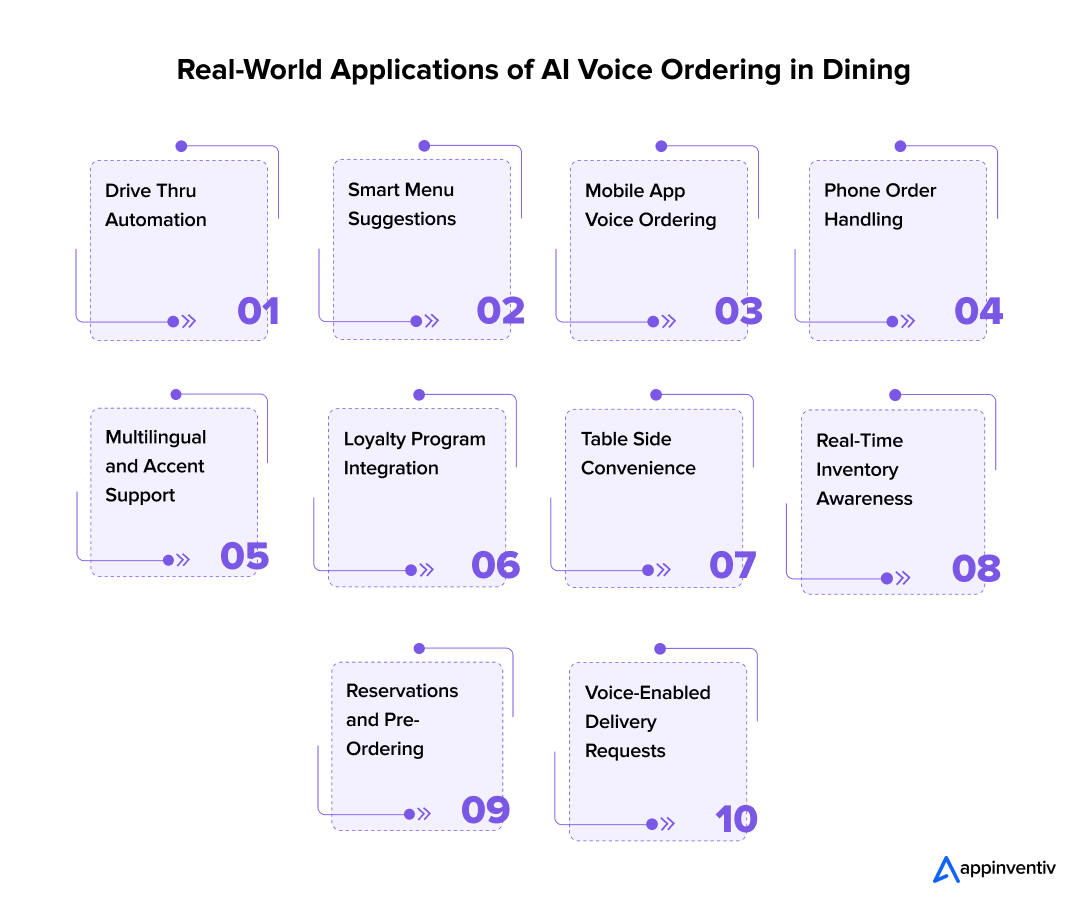
1. Drive Thru Automation
AI voice agents for restaurants can maintain a consistent ordering sequence even when drive-thru demand rises. They can confirm meal sizes, capture modifiers, recommend relevant additions, and send structured order information directly to kitchen systems.
Example: McDonald’s worked with IBM after buying Apprente to test Automated Order Takers at more than 100 US locations. The trial got about 85% order accuracy. McDonald’s stopped the program in 2024 to improve the technology, but the project showed that AI-powered voice systems could really boost speed and performance in drive-thru operations.
2. Smart Menu Suggestions
Restaurant voice AI can sell extras and suggest add-ons naturally by recommending sides, combo meals, or seasonal items while taking the order. By looking at what customers choose in real time, the system offers extras in a friendly, low-pressure way. This raises order totals while making the experience more interesting.
Example: Wendy’s rolled out FreshAI, a voice helper built with Google Cloud, in its drive-thrus. When customers order a burger, the system might suggest adding fries, drinks, or special deals like a Frosty. By 2025, Wendy’s planned to bring FreshAI to 500 to 600 locations across the US, making suggestions part of every order.
Also Read: How Can Google Voice Assistant Make Businesses Efficient?
3. Mobile App Voice Ordering
Mobile-based AI voice for restaurants can also use saved customer information to simplify repeat purchases. With the appropriate permissions, it can retrieve a previous order, apply loyalty rewards, identify the preferred outlet, and confirm the payment method through a short conversation.
Example: Domino’s Pizza created “Dom,” a voice helper powered by Nuance, for its mobile apps. Customers can say, “I’d like a large pepperoni with extra cheese,” and the system handles the request right away. This feature, which combines convenience with new technology, has helped Domino’s stay ahead in digital ordering in the fast food business.
4. Phone Order Handling
One of the most useful AI voice ordering use cases is managing lots of phone calls. AI voice ordering for restaurants helps prevent abandoned calls by answering several customers simultaneously. The technology can take orders, explain menu choices, apply available offers, collect payment details, and confirm pickup or delivery without placing callers on hold.
Example: Panera Bread implemented AI bots to handle phone-in catering orders at several US locations. The system captures large, complex requests efficiently, improving both speed and customer satisfaction for business and family orders.
5. Multilingual and Accent Support
One of the biggest benefits of AI voice ordering in restaurants is how well it works with different languages and regional accents. By training AI systems to understand many different voices, tones, and dialects, restaurants can make sure every customer gets heard correctly. This stops order mix-ups and makes dining experiences more welcoming for communities that appreciate cultural understanding.
Example: Burger King tried out multilingual voice AI in South Florida, where many people speak both languages. The system easily switched between English and Spanish, taking orders clearly and avoiding mistakes that human workers might make during rush periods. This test showed how AI can remove barriers in fast-moving situations while making things more accessible.
6. Loyalty Program Integration
With restaurant automation with AI, loyalty programs can work smoothly with voice interactions. Customers don’t need to show physical cards or enter app codes anymore. Instead, the AI can spot returning customers through phone numbers, profiles, or payment methods, and then automatically add loyalty points, discounts, or personalized deals. This makes the customer experience smoother while bringing people back more often. It also enables businesses to track buying habits and adjust their marketing strategies for better results.
Example: Dunkin’ tried AI-connected loyalty ordering in certain US markets. When a regular customer ordered a medium iced coffee, the AI automatically suggested a free upgrade or used saved points toward a donut. This direct link between ordering and rewards not only made customers happier but also built stronger brand loyalty.
Also Read: Customer Loyalty App Development – Benefits, Process, Costs
7. Table Side Convenience
In casual dining, customers often have to wait for servers to get free before they can ask for more things. Voice enabled ordering solutions help address this problem by putting control in the hands of diners. Using voice-activated kiosks, tablets, or even smart devices at the table, customers can order appetizers, refills, or desserts without waiting. This reduces delays, especially in restaurants where staff handle large sections during busy times, and creates a more comfortable dining experience.
Example: Olive Garden tested AI-powered table kiosks in crowded US locations. Guests could ask for extra breadsticks, order drinks, or add entrees through simple voice commands. The system sent instructions straight to the kitchen or bar, making service faster while letting servers focus on hospitality and customer interaction.
8. Real-Time Inventory Awareness
Restaurants constantly struggle with managing stock levels during busy periods. By connecting to inventory software, AI for food ordering can give real-time updates about what’s available. When something runs out, the AI right away suggests replacements, preventing customer disappointment. This also helps kitchens cut down waste by highlighting items that need to be sold before they go bad. The system works for both dine-in and drive-thru settings, improving operational efficiency.
Example: Shake Shack tested inventory-connected AI voice ordering at several US locations. If a store was out of frozen custard, the system immediately offered alternatives like milkshakes or floats. Customers liked the honesty, while management saw fewer refund requests and better stock rotation. This approach improved both customer happiness and behind-the-scenes operations.
9. Reservations and Pre-Ordering
Another strong way to use contactless voice ordering is to mix reservations with meal pre-orders. Instead of waiting to order after sitting down, customers can use voice assistants to book tables and pick menu items ahead of time. This enables kitchens to prepare food early, resulting in faster service and shorter wait times for diners. It also speeds up table turnover rates, which directly helps revenue in popular restaurants.
Example: The Cheesecake Factory tried voice-driven reservations with built-in pre-ordering in certain city locations. Guests booking for big groups could reserve a table and pre-order family platters or signature cheesecakes. When the party showed up, the food was ready quicker, creating a smoother experience while taking pressure off the kitchen staff.
Appinventiv’s Insights
Leverage pre-order patterns to suggest complementary products/promotions, which will boost the upselling and add to the guest experience. These trends can be analyzed over time to improve the menu and marketing plans to suit the customer preferences.
10. Voice-Enabled Delivery Requests
For takeout and delivery, contactless voice ordering lets customers place orders through smart speakers, car systems, or voice-enabled apps without physical menus or phone calls. The AI helper can confirm items, handle payments safely, and give delivery updates. This hands-free method suits modern lifestyles, particularly when customers are engaged in other activities at home or driving. It also adds safety by reducing contact points.
Example: Papa John’s worked with Amazon Alexa to let customers reorder their favorite pizzas just by talking. A customer could say, “Alexa, order my usual from Papa John’s,” and the system would automatically handle the saved order. This feature increased repeat orders and made Papa John’s one of the first pizza chains to use smart home technology in the US market fully.
How to Implement Voice AI in Your Restaurant
Successful adoption of voice AI begins with selecting the right solution for your restaurant and integrating it seamlessly into existing operations. Here are some of the key steps to follow for seamless integration of voice ordering system for restaurants:
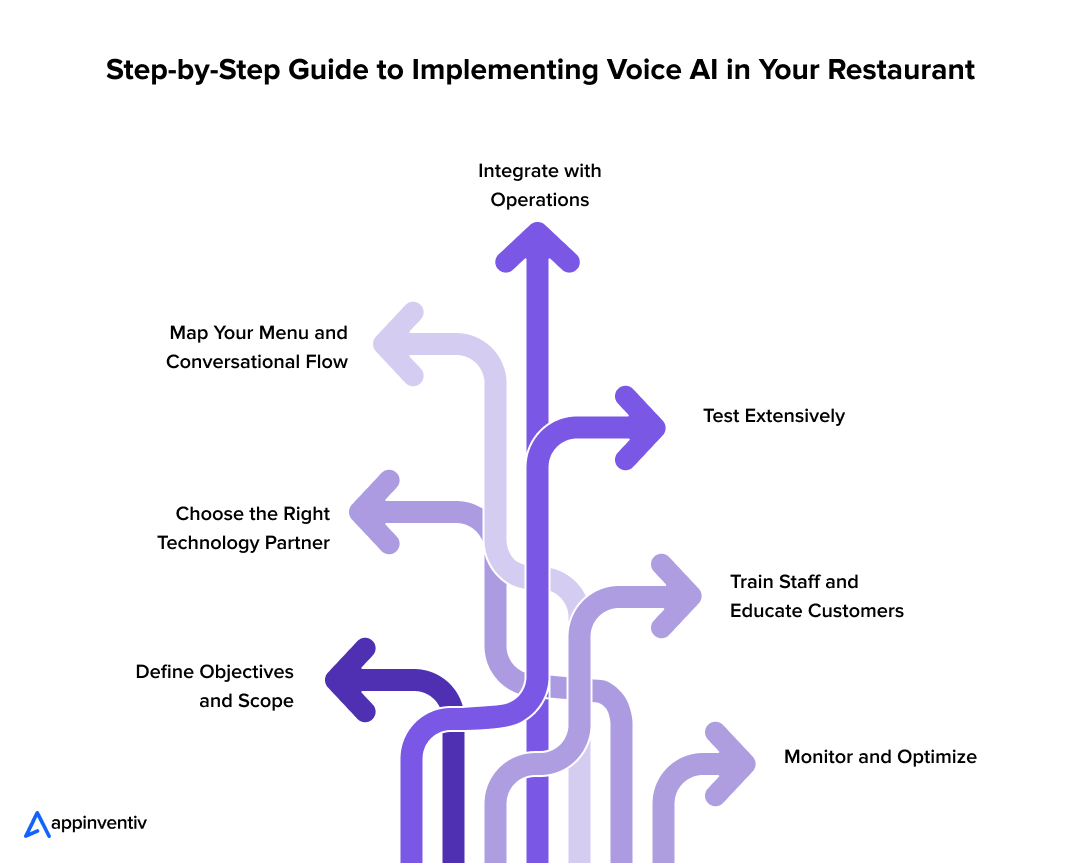
1. Define Objectives and Scope
Start by identifying what you want conversational AI for restaurants to accomplish. Maybe faster drive-thru service, fewer order errors, or better upselling opportunities. Define clear objectives to help choose the right technology and plan.
Set measurable targets so you know the system delivers real results and aligns with your operational strategy. Understanding goals up front makes tracking ROI and measuring success much easier over time.
2. Choose the Right Technology Partner
Selecting the right voice AI food ordering system for restaurants is critical. Look for a provider that integrates well with your existing POS, kitchen displays, and mobile apps. A partner who customizes the voice assistant to match your menu, brand voice, and workflow will create smoother adoption and higher ROI.
Evaluate providers on their support for updates, analytics, and multi-channel ordering capabilities for long-term scalability.
The best voice AI for restaurants is not necessarily the platform with the longest feature list. It is the one that understands the restaurant’s menu, integrates with its existing systems, performs reliably in noisy environments, and provides measurable improvements in order completion, accuracy, and cost.
3. Map Your Menu and Conversational Flow
Team up with your provider to build detailed conversation maps for personalized food ordering with AI. Put in every menu item, ways customers can change orders, and extras like combos or deals.
Effective conversation planning reduces mistakes, boosts upselling, and makes conversations feel natural. This lifts the whole customer experience. Smart menu mapping also ensures that complex orders get done right, requiring less staff assistance and resulting in faster order times.
4. Integrate with Operations
Your voice recognition ordering system needs to integrate seamlessly with either cloud or legacy POS, kitchen screens, and loyalty programs. Proper integrations enable orders to move independently, require fewer manual interventions, and maintain consistent operations.
Your team’s work should improve, not deteriorate. The system becomes part of how you run things every day. Integrating also allows you to track inventory and order patterns in real-time, enabling you to make more informed business decisions.
5. Test Extensively
Try the system at a few locations or with part of your menu before going big. Testing helps you identify unusual situations, improve AI recognition, and verify accuracy. This step also lets you see the impact of voice AI ordering on the restaurant industry in your own place, like better order speed, fewer mistakes, and satisfied customers.
Before launching voice ordering for restaurants at scale, teams should test real calls containing background noise, pauses, corrections, accents, substitutions, and complex modifiers. These scenarios show whether the technology can recover from misunderstandings without frustrating customers or creating incorrect orders.
6. Train Staff and Educate Customers
Your team should know how to work with the system and help customers when they need it. Teaching your guests about contactless voice ordering shows them how easy and safe it is, getting them to try it.
A clear, transparent communication process makes the change smooth for workers and customers alike. Regular team training also helps you spot ways to make the workflow better, making the system work even stronger.
7. Monitor and Optimize
Continue to monitor how things perform, such as order accuracy, peak times, and which menu items are most popular. Data from the voice AI food ordering system for restaurants lets you make it better bit by bit, making the AI smarter as time goes on.
When you improve things based on real numbers, you can run things better, sell more extras, and give customers a good experience every time. Watching regularly also helps you see what customers do, guiding your future menu changes and marketing plans.
A restaurant AI voice agent should improve as it processes more real-world conversations. Restaurants can review failed interactions, frequently misunderstood items, rejected recommendations, escalation rates, and abandoned orders to refine the system continuously.
We help you integrate the right system seamlessly into your restaurant operations, boosting efficiency and improving customer experience

Voice Ordering System Challenges and How to Solve Them
The unresolved problematic aspects within voice AI systems may interfere with the work process, lead to slow services, and cause visitor dissatisfaction, which can ultimately affect sales and loyalty. These issues need to be addressed to make sure that the technology provides a good, consistent, and lucrative experience.
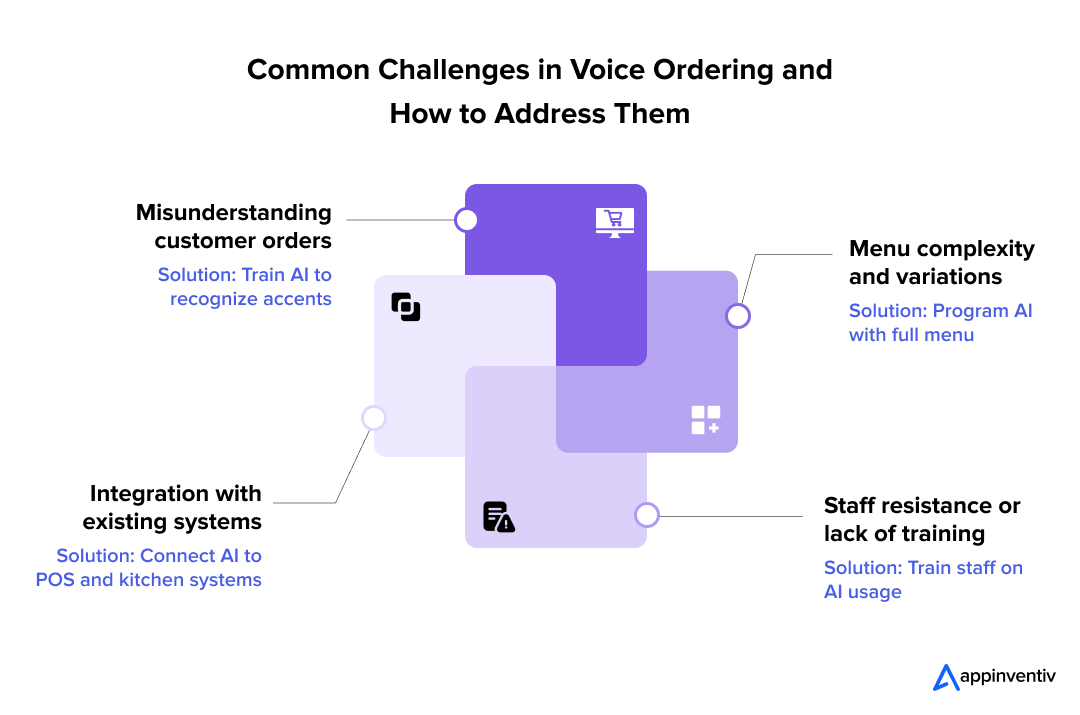
Misunderstanding Customer Orders
Challenge: Background noise, accents, or rushed speech can lead to incorrect orders, frustrating customers, and increasing error rates. These problems hurt trust in the system and can make service slower.
Solution: Set up an AI voice ordering that’s been taught different speech styles and real-world audio situations. The system continues to learn, improving its ability to understand accents, the way people speak, and complex requests. This means more accurate orders and smoother service.
Menu Complexity and Variations
Challenge: Big menus or lots of customization options might trip up the AI, causing it to miss changes or give wrong upsell ideas. This affects the accuracy of orders and makes customers less satisfied.
Solution: Develop a comprehensive voice ordering system for restaurants that encompasses every item, choice, and deal offered. Rolling it out slowly and keeping an eye on things lets the AI handle complicated stuff well while staying fast and accurate.
An AI voice agent for restaurants must understand how customers naturally describe menu items rather than depending only on exact product names. Training should cover regional expressions, meal combinations, substitutions, dietary requests, portion sizes, and frequently requested modifications.
Businesses can further partner with firms like Appinventiv to leverage their AI voice agent development services and build systems trained around complex menus, modifiers, regional offerings, upselling rules, and real ordering patterns.
Staff Resistance or Lack of Training
Challenge: Workers might feel scared of new tech or worry about losing their jobs. When staff don’t receive proper training, they struggle to assist customers with the system effectively, which can exacerbate issues.
Solution: Give thorough training on restaurant voice AI, showing how it takes care of boring repeated tasks and helps staff instead of kicking them out. Good guidance gets people on board and makes work flow better.
Integration with Existing Systems
Challenge: Older POS and kitchen systems might not connect well with AI platforms, causing slowdowns, mistakes, or things running poorly.
Solution: Build an AI-powered ordering system that works completely with POS, kitchen displays, and loyalty programs. Testing it first ensures everything runs smoothly and aligns with your existing workflow before you make a full commitment.
How Appinventiv Can Implement an AI Voice Ordering System?
AI voice ordering isn’t just a future idea anymore. It has become a main way to boost efficiency and improve customer experience in the restaurant business. Its full power shows when connected with bigger digital systems, linking voice AI with analytics, smart kitchen displays, IoT-enabled equipment, and loyalty programs.
Our approach to voice AI for restaurants begins with the operating workflow rather than the conversation interface alone. We assess call volumes, ordering channels, menu complexity, POS architecture, kitchen processes, payment requirements, and human escalation rules before defining the solution.
Through our AI integration services, we help brands bring voice AI smoothly into their operations, enabling faster and more accurate service, creating smoother workflows, and providing a personalized guest experience that drives repeat business.
Our restaurant AI app development services integrate seamlessly with voice AI, enabling ordering, delivery, payments, and customer engagement to function together across digital channels. We have successfully worked with brands like Pizza Hut, KFC, Domino’s, and Americana ALMP, helping them implement solutions that make both the frontend and backend smoother.
For instance, for Pizza Hut, we collaborated on a transformative app and voice AI design that redefined their digital ordering experience. The solution contributed to a 30% increase in conversion rate and secured over 50,000 app downloads. These outcomes show how Voice AI ROI for restaurants can be measured through higher conversions, stronger digital adoption, and improved customer engagement.
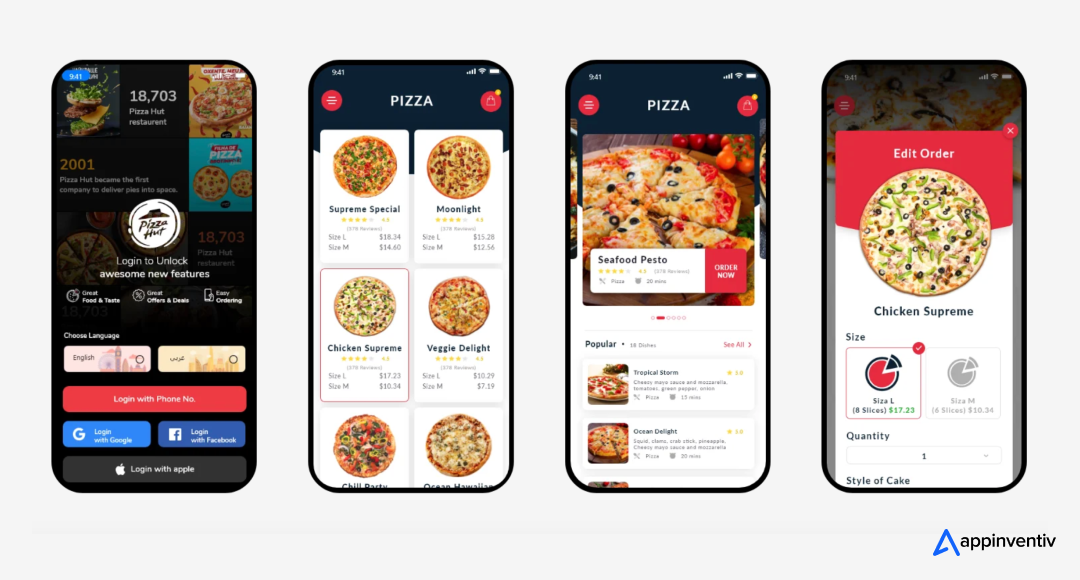
Looking forward, we keep exploring new ideas like augmented reality menus, digital twins for kitchen management, and smart loyalty programs. With Appinventiv’s food delivery app development services, restaurants gain solutions that are reliable, scalable, and flexible, making AI voice ordering a key component of smarter, more efficient, and profitable operations.
Our AI voice agent development services can take this progress further by enabling restaurant systems to act on real-time operational signals. These systems can coordinate orders, inventory, kitchen capacity, delivery updates, and customer requests across connected platforms, while keeping employees in control of important decisions.
Connect with our experts today and transform your restaurant with AI voice ordering system!
FAQs
Q. How can voice AI be used in retail curbside pickup or drive-thru ordering?
A.Voice AI enables automated order taking for curbside pickup and drive-thru by understanding natural speech, confirming items in real time, and integrating with POS and inventory systems. It reduces wait times, handles order modifications, supports upselling, and ensures seamless order routing to kitchens or fulfillment teams during peak hours.
Q. What are the top voice AI options for small restaurants?
A.Top voice AI options for small restaurants include cloud-based AI voice ordering platforms, conversational AI systems with menu recognition, and managed voice AI services. These solutions offer quick deployment, POS integration, scalable pricing, and minimal hardware requirements, making them suitable for single-location or growing restaurant businesses.
Q. How do you choose the right AI voice solution for a restaurant?
A.Choosing the right AI voice solution depends on speech accuracy, background noise handling, POS compatibility, and customization flexibility. Restaurants should assess scalability, multilingual support, security standards, and long-term optimization capabilities to ensure the AI voice system supports both current operations and future expansion.
Q. What are the common use cases for voice AI in restaurants?
A.Common voice AI use cases in restaurants include automated phone and drive-thru ordering, self-service kiosks, reservation handling, order status inquiries, and AI-driven upselling. Advanced voice AI systems also support multilingual interactions and integrate with CRM and loyalty platforms to enhance customer engagement.
Q. How can voice AI improve restaurant order accuracy?
A. Voice AI improves restaurant order accuracy by capturing orders directly from customers, validating menu items in real time, and eliminating manual input errors. It standardizes order flows, reduces miscommunication during peak hours, and ensures precise data transfer to POS and kitchen systems.
Q. How much does an AI voice ordering system cost?
A. Building a voice ordering system for restaurants typically costs between $30,000 and $300,000, depending on the size and complexity of the system. Basic solutions will cost closer to $30,000- $50,000 to smaller restaurants or single locations, whereas mid-sized chains will require a budget of between $75,000 and $150,000.
Enterprise-level voice-enabled ordering solutions development will typically cost more than $200,000- $300,000 in addition to the costs of connections, training, and maintenance. Factors such as custom menu setup, AI capabilities, POS integration, and ongoing support all influence pricing. The broad spectrum offers flexibility in restaurants across various levels of digital transition.
Q. How does AI voice ordering improve customer experience?
A. A voice ordering system for restaurants makes the customer experience better by offering quicker service, cutting down order mistakes, and giving personalized suggestions. The AI learns customer preferences over time, making interactions smooth and efficient.
Q. How secure is AI voice ordering for payments?
A. Restaurant voice AI systems use encrypted transactions and tokenized payment methods to protect customer information. This makes sure that payments made through a voice AI ordering system meet industry standards for security and compliance.
Q. What are the recommended voice AI tools for optimizing restaurant efficiency?
A. The recommended voice AI tools that can optimize restaurant efficiency are solutions that support accurate speech recognition, POS integration, menu customization, multilingual conversations, analytics, secure payments, and employee handover. Restaurants should compare platforms using their actual menu and ordering environment instead of relying only on general product demonstrations.
Q. Which voice AI solutions boost restaurant operations?
A. Businesses evaluating which voice AI solutions boost restaurant operations should prioritize platforms that reduce abandoned calls, improve order accuracy, support intelligent upselling, and connect with existing POS and kitchen systems. The right choice depends on restaurant size, order volume, menu complexity, and expansion plans.
Q. How are voice AI restaurants different from traditional restaurants?
A. Operators researching voice AI restaurants are generally looking for businesses that use conversational technology to handle phone, drive-thru, kiosk, or mobile orders. These restaurants automate repetitive ordering tasks while keeping employees available for food preparation and in-person service.


Fast 2-minute response, fully NDA-protected.

Key Takeaways Design your system architecture around clean sensor data, hybrid edge-cloud computing, medical record connections, and continuous algorithm monitoring. Handle diverse wearable devices using unified data schemas, real-time message channels, signal filters, and dedicated hardware adapters. Stream wearable metrics into hospital databases using FHIR standards, HL7 protocols, identity matching, and background middleware. Test AI…

How to Use AI SDR Agents to Automate Outbound Prospecting and Generate Pipeline
Key takeaways: AI SDR agents replace repetitive manual research with autonomous, signal-driven prospecting and lead qualification workflows. Start with one defined prospecting workflow before expanding AI automation across the wider sales organization. Clear ICP rules, reliable data, and decision boundaries determine whether autonomous prospecting creates useful business value. Custom AI SDR workflows work best when…

AI for Smart Cities: From Connected Infrastructure to Intelligent Urban Services
Key takeaways: AI shifts cities from monitoring infrastructure conditions to predicting disruptions and improving operational responses before failures escalate. The strongest AI use cases in smart cities combine quality data, clear ownership, workflow integration and measurable infrastructure outcomes. Digital twins create greater value when AI supports simulation, optimisation and decisions rather than visualisation alone. Responsible…